
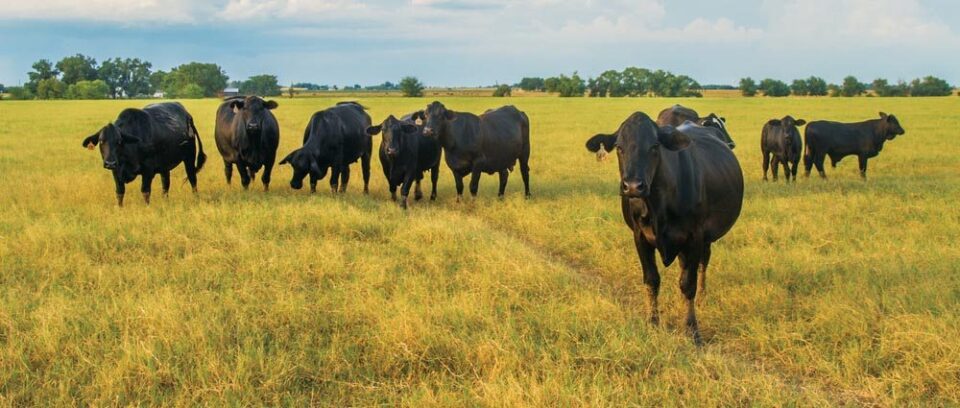
Rotational grazing is widely promoted for its benefits to pasture health, soil conservation, and long-term farm profitability. However, adoption among cow-calf producers remains relatively low, with concerns over labour demands, infrastructure limitations, and management complexity slowing uptake.
Limited Uptake Among Producers
According to data from the United States Department of Agriculture (USDA), only about 40% of cow-calf operations use some form of rotational grazing. Even fewer — just 16% — apply intensive grazing systems with paddock rotations of 14 days or less.
Carson Roberts, state forage specialist with the University of Missouri Extension, notes that many producers believe the additional daily labour required for moving cattle does not justify the perceived gains.
While experienced operators can move cattle in 15 to 45 minutes per shift, labour requirements vary widely depending on herd size and paddock structure. Roberts’ research indicates that daily labour costs can range from as little as one cent per cow to as much as 50 cents per cow, depending on rotation frequency and herd scale.
Herd fragmentation is another major efficiency challenge. In one example, a producer managing 350 cows across 17 groups and 93 paddocks required more than 12 hours per day for daily moves. Even shifting to twice-weekly rotations consumed approximately two hours daily.
Water and Performance Challenges
Roberts points out that water infrastructure, rather than fencing, is often the primary constraint limiting successful rotational grazing. When cattle must walk more than 800 feet to access water, intake declines and grazing patterns become uneven. This can result in back-grazing, trailing, and soil damage (pugging), particularly in damp conditions.
Some producers also express concern that calves may wean at lighter weights under rotational systems. Although production per acre typically increases due to higher stocking rates, individual animal performance may decline slightly. Experienced graziers often accept this trade-off in exchange for improved overall output, but others revert to conventional systems to prioritise individual gains.
Seasonal variability further complicates management. Drought and inconsistent pasture growth can quickly undermine rigid rotational schedules. Without adjustments to rest periods and stocking rates, overgrazing may still occur despite rotational systems being in place.
Practical Strategies to Improve Success
Roberts outlines several practical steps producers can take to capture the benefits of rotational grazing without overwhelming labour demands:
1. Set Economically Smart Rotation Intervals
Weekly cattle moves often provide most of the benefits — including improved forage recovery and soil health — without the heavy labour burden of daily rotations. For many smaller operations, weekly rotations strike an effective balance.
2. Consolidate Herds
Combining smaller groups into a single, larger herd reduces labour per head and enhances grazing efficiency. Concerns about trampling or bull behaviour are frequently overstated, and well-managed larger groups can improve both pasture condition and animal performance.
3. Prioritise Water Infrastructure
Ensuring water access within 800 feet improves forage utilisation and reduces soil damage. Roberts emphasises that investing in water systems often delivers faster returns than installing additional fencing or adopting virtual fencing technologies.
4. Monitor and Adjust Continuously
Producers should regularly assess cow body condition, manure consistency, and pasture residuals. Well-formed dung pats, adequate forage cover, and maintained body condition are key indicators of system performance. Observations should guide adjustments in stocking density, rotation timing, and supplementation.
5. Build Flexibility Into Stocking Plans
Pasture growth fluctuates year-to-year. Producers should prepare for drought by maintaining hay reserves, designating sacrifice paddocks, or destocking early when necessary. Flexible rest periods are critical to protecting pasture recovery.
Roberts stresses that rotational grazing is designed to increase total production per acre rather than maximise individual animal gains. When properly managed, the system can deliver sustainable returns without excessive daily labour.
He also encourages producers to participate in grazing schools and extension programmes to strengthen management skills and improve long-term success.
