


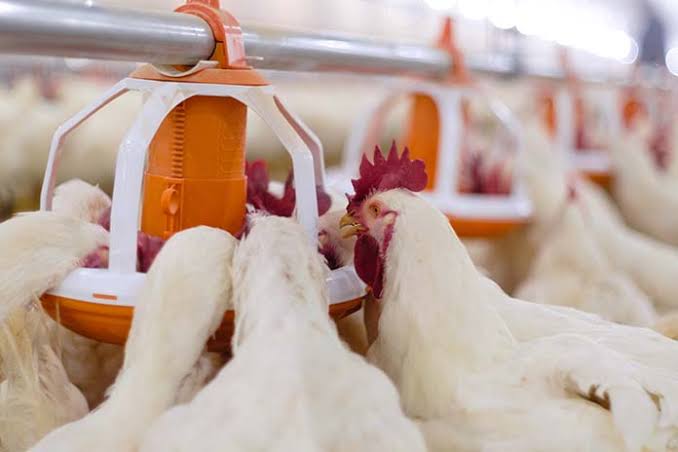
When talking about broiler breeders, the first idea is always to talk about management of the breeder females, uniformity, feed distribution, performance of lay, etc. But we should not forget the males as they represent 50% of broiler genetics and of the equation during the production period: producing eggs that are not fertile are useless!
This article highlights the main points of management of the Hubbard M77 breeder males to maximise the fertility rate of the flock and with that the number of chicks per hen housed.
REARING PHASE
It all starts with the rearing phase to properly prepare the males for the production period.
A successful brooding period will ease the management of the birds for the rest of their life. Therefore, focusing on the first weeks of life is very important. To achieve the bodyweight (BW) targets there are some important points of attention:
- house environment: temperature, ventilation, litter quality, ;
- feed presentation: crumble feed helps the feed intake, growth and uniformity. Ad libitum feeding during the first 2 weeks or until 3 weeks of age if the 2 weeks bodyweight target is not achieved;
- light: sufficient light intensity (minimum 60 lux) and duration. The duration of hours of light program can be extended if 7 days and 14 days bodyweights are not achieved.
Once the brooding period has finished and the males are given full access to all the rearing space and are fed with their own feeding system, the focus shall be on bodyweight management and uniformity. The more uniform the birds will be, the easier they will be to manage in production. Therefore, a first grading of the flock shall be performed latest by 4 weeks of age to separate Small, Medium and Large birds in different pens. After the first grading, a minimum of 80% uniformity should be obtained in each pen. Then the feed allocation must be adjusted according to the average bodyweight of each pen with the objective to merge the birds in the Small and Large pen to the Medium pen while maintaining a good flock uniformity. Four weeks after the 4th week grading, the pen with the small males must reach the 8 weeks bodyweight target to secure skeletal development which is almost completed at this age. Gradings can be performed every 4wks if the uniformity of the birds is decreasing.
If the uniformity is decreasing after the gradings, investigations around the feed distribution must be conducted. A good and uniform feed distribution is the key to maintain or improve the flock uniformity. To do so:
the feed must be uniformly distributed in less than 4 minutes;
use of mash feed is highly recommended to maintain an eating time of at least 45-60 minutes;
adjustment of feeding space and feeder height must be performed on a regular basis to match the birds’ requirements.
Development of the sexual maturity starts from 16 weeks of age and will last until approximately 30 weeks of age. In that sense, it is important to avoid disruption in growth between 16-22 weeks (+150-160 g/week), especially when changing feed type and after vaccinations.
PRODUCTION PHASE
After the rearing period, comes the time when males will be mixed with the females with the final objective to produce as many good quality fertile eggs.
The first stage of this period is critical as birds are still evolving a lot in terms of bodyweight, maturity and behaviour.
Mixing is crucial to establish a good interaction between males and females. Only males showing the following criteria should be mixed:
- good sexual maturity: singing, well developed red combs and wattles;
- correct breast shape (score 2 or 3);
- straight and strong legs;
- target bodyweight achieved, and uniform
Never mix shy and/or immature males.
Progressive mixing is preferred to achieve the best results:
- 5% of males between 22-24 weeks with a gradual increase to 5% at 25 weeks of age.
- More than 5% males could be a risk to maintain good feathering and nesting behaviour of the females.
The risk of excessive weight gain and/or loss of condition up to 28 weeks is high. Therefore, it is recommended to use a proper grill size of 45 mm width and 60 mm height, or to adjust the pan feeders on a regular basis to control male access to the female feeders. Also ensure that the corners of the feed tracks are well sealed with covers. Make sure to check male behaviour throughout the day to see if they are stealing female feed and check the feed distribution at least 2 times per week at first and then every week.
Once the males are fully mature and the females are reaching peak of lay around 30 weeks of age, the weekly bodyweight gain of the males should be reduced to 20-25 gram per week. To do so, the use of a specific low protein male feed is a good option to help to maintain the males in good condition.
Weekly control of the bodyweight of the males (3-5% of the flock and at least 60 males/pen) and the condition of the males by looking at the fleshing (shape and amount of breast), footpads, and vent is essential:
During the second phase of production, male replacement can be considered to maintain fertility after 40-45 weeks of age, but only if all biosecurity risk controls are fully respected. Another option is to perform “Intra-farm” male replacement where males can be exchanged between houses.
Finally, never forget that one of the main ingredients for the birds’ diet is water, and its quality should always be under control with the following targeted levels:
- pH between 5 to 6.8;
- a Redox potential > 600 mV with chlorine;
- Chlorine concentration at the end of the water pipe of 1 ppm, with an acceptable range: of 5 to 3 ppm.
CONCLUSION
Proper management of breeder males is essential to maximise flock fertility and the number of chicks produced per hen housed. Successful results begin during rearing, with close attention to brooding conditions, bodyweight development, uniformity, feed distribution and skeletal growth. During production, only mature and well-conditioned males should be mixed with females, while the male ratio, bodyweight gain, feeding behaviour and physical condition must be monitored regularly.
Maintaining fertility throughout the production cycle requires continuous observation and timely corrective actions. Male feed stealing, excessive bodyweight, poor fleshing condition, leg problems, and inadequate water quality can all compromise mating activity and reproductive performance.
Males represent 50% of the flock’s genetic potential, and their management should receive the same level of attention as female management. Healthy, uniform and active males, managed according to their physiological needs at each stage, are the foundation for achieving high fertility, good hatchability and the greatest possible number of quality chicks per hen housed.
