

Disease outbreaks, high maintenance costs, and fluctuating markets are constant challenges for piggeries, often leading to production delays and financial losses. Riversdale Piggery, located outside Riversdale in the Western Cape, has developed a model that maximises efficiency and profitability by combining strict biosecurity with an innovative feed programme that repurposes a dairy by-product.
Officially launched in 2020, Riversdale Piggery is jointly owned by Number Two Piggeries, a company with holdings in pork and dairy production, and Jireh Foods, which operates several diversified farms and a local dairy. The collaboration allows Number Two Piggeries to supply piglets while Jireh provides whey — a nutritious by-product from cheesemaking — to feed the growing pigs. This arrangement creates a market for the piglets while turning waste into a valuable feed resource.
Jan Streicher, manager of the piggery, brings over two decades of industry experience. He oversees operations alongside his wife, Susan, who manages the weaner piglets, and his son, Simon, the assistant manager, with six additional full-time staff. Riversdale Piggery operates exclusively as a boar weaner-to-grower farm, sourcing piglets from Alexandershoek Piggery in Moorreesburg. This farrow-to-weaner unit, also owned by Number Two Piggeries, houses 3,240 sows, allowing Riversdale to avoid the costs and risks associated with breeding their own piglets.
By keeping the sow operations separate, the farm mitigates the risk of disease outbreaks such as African swine fever, ensuring that a single incident does not halt the entire production cycle. The separation also allows for tailored feeding and growth cycles: sows are reared for longer periods, while boars are sent to market before 160 days to prevent boar taint, a quality issue in mature males.
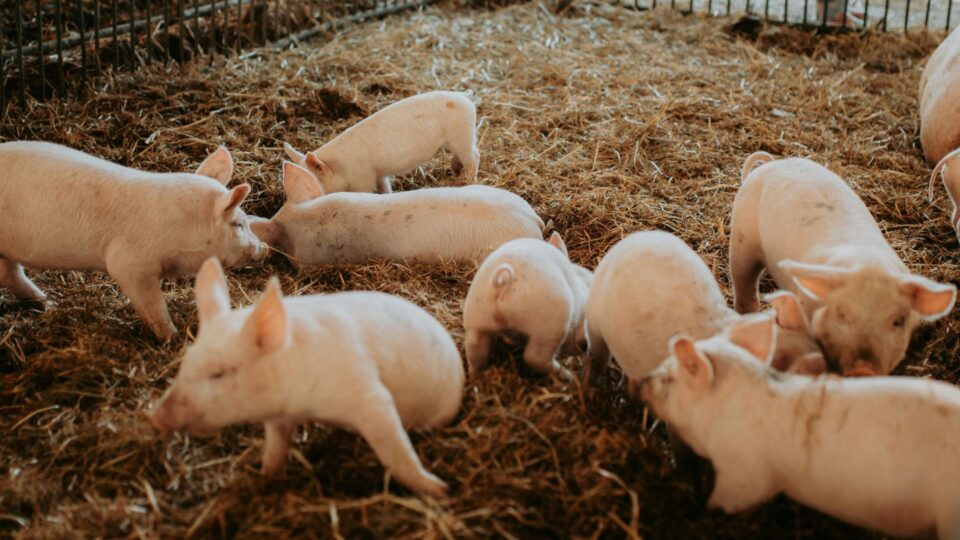
Riversdale Piggery currently houses 14,000 Landrace and Large White pigs across seven large housing units, with space allocations of 1 m² per grower and 0.4 m² per weaner. Each week, 750 weaned piglets, averaging 26 days old and weighing 8 kg, arrive from Alexandershoek. The sows are artificially inseminated using PIC 337 genetics, achieving an 87.6% farrowing rate and producing up to 31 piglets per sow annually.
New arrivals spend 38 days in the weaner units, which are maintained at 28°C under automated temperature control to support thermoregulation in the young pigs. Each piglet receives a daily intake of 1.45 kg of dry feed mixed with 6 litres of whey in a 1:3 ratio, delivered via a liquid feeding system eight times per day. After this phase, weaners reach an average of 26.5 kg and are moved to grower units for approximately 92 days until reaching a market weight of 121 kg. Daily weight gain averages 500 g in weaners and over 1 kg in growers, supported by carefully formulated feed blends and continued whey supplementation.
Whey, rich in protein and minerals, plays a critical role in the feeding programme. Its use not only promotes rapid and consistent weight gain but also significantly reduces feed costs. The piggery receives 35,000 litres of whey per day, over 200,000 litres weekly, paying only for transportation. The grower feed, produced on-site from maize, soya oilcake, and a premix recommended by an animal nutritionist, is adjusted according to the pigs’ growth stage.
To maintain efficiency, the farm uses an automated Big Dutchman liquid feeding system that monitors age and weight to deliver the correct volumes. Staff regularly inspect the system to prevent blockages or leaks, while all pens are disinfected as pigs move between units. Riversdale maintains a feed conversion ratio of 2:1, meaning 2 kg of feed supports 1 kg of growth.
Sustainability extends beyond feed. Pig manure is collected and processed to provide compost and irrigation water for Jireh Foods’ crop farms, enhancing soil health and reducing fertiliser costs. Solids and liquids are separated using a press system, ensuring safe application and adherence to internal and external audits.
Strict biosecurity protocols are a cornerstone of operations. The farm is fenced, with cement barriers preventing entry by stray animals. Trucks pass through a decontamination booth, staff and visitors shower and change clothing, and footbaths and compartmentalised pens prevent disease spread. External drivers maintain distance during loading and unloading, and all ramps are disinfected afterward. Blood tests for high-risk diseases, including foot-and-mouth, classical swine fever, and African swine fever, are conducted twice yearly. These measures have preserved the farm’s strong herd health.
Despite market fluctuations and the inherent risks of pig farming, Riversdale Piggery demonstrates that careful management, innovative feeding practices, and rigorous biosecurity can deliver a profitable, efficient, and sustainable piggery operation.
