
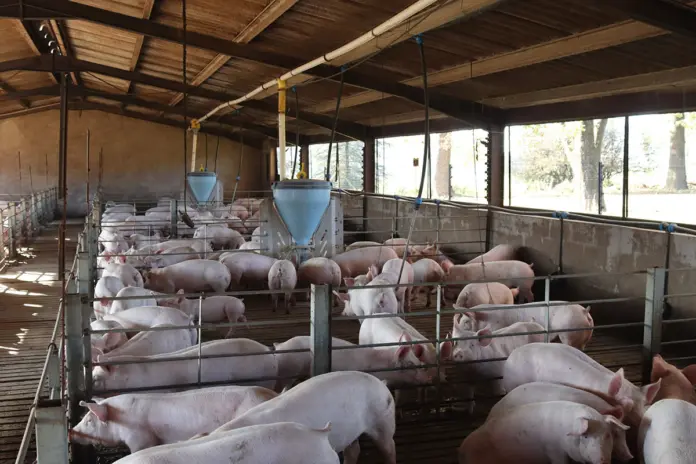
South Africa’s pig industry is preparing for a major shift as producers transition away from gestation crates, but experts say successful group housing requires far more than simply increasing floor space.
Under the South African Pork Producers’ Organisation (SAPPO) revised welfare code, gestation crates will be phased out by 1 January 2032, while minimum space per sow will increase to 2.25m². Although the new standards focus on animal welfare, research shows that housing design, feeding systems, ventilation and day-to-day management will ultimately determine whether the transition improves both welfare and productivity.
A review by the US National Pork Board found that factors such as group size, pen layout, feeding systems and animal management have a greater influence on performance than floor space alone. Simply providing more room does not eliminate competition, stress or aggression if housing systems are poorly designed.
Cara Nel, monogastric development manager at Vitam International, says environmental conditions remain one of the biggest drivers of production efficiency.
“Housing design is one of the most important determinants of environmental stability, yet many production systems have not kept pace with the needs of modern herds,” she says. Poor insulation, inadequate ventilation and temperature fluctuations increase stress, reduce feed efficiency and negatively affect overall performance.
Feeding systems must be part of the design
Researchers emphasise that housing design and feeding systems should be planned together rather than treated as separate decisions.
Electronic Sow Feeding (ESF) systems can improve individual feed management, but if feeder capacity is insufficient, dominant animals often gain priority while younger or subordinate sows struggle to access feed. Overstocked feeding stations increase aggression, injuries and uneven feed intake.
Nel notes that poorly adjusted feeders also contribute to feed wastage through spillage, feed sorting and inconsistent intake. Since feed remains the largest production cost, losses of between 5% and 15% can significantly affect profitability.
Managing behaviour reduces stress
The review highlights the importance of designing facilities around natural pig behaviour.
Aggression is greatest when new groups are formed, making larger mixing pens or pens with partitions and escape areas particularly valuable during the first few days. Static groups generally experience fewer disruptions than dynamic groups, where new animals are introduced regularly.
Design improvements such as single-pass feeding systems, controlled-entry gates and separate exit areas can also reduce bottlenecks and improve feeder access.
Ventilation remains critical
Environmental control is equally important as producers move toward group housing.
Temperature extremes reduce feed intake and feed conversion efficiency, while poor ventilation increases ammonia and carbon dioxide levels that further suppress appetite and animal performance.
South African summer conditions make cooling, ventilation and unrestricted access to clean water essential, particularly as larger litters and higher stocking densities place additional pressure on production systems.
An integrated approach
Researchers conclude that there is no universal group housing system suitable for every farm. Success depends on integrating housing design, feeding strategy, ventilation, stocking density and daily management into a single production system.
For South African producers preparing for the 2032 transition, meeting minimum space requirements is only the starting point. Long-term productivity and animal welfare will depend on creating housing systems that minimise competition, maintain environmental stability and support consistent feed intake.
As Nel concludes, the greatest improvements in performance are achieved when housing, nutrition, ventilation and management work together to support pig comfort, health and efficiency.
