
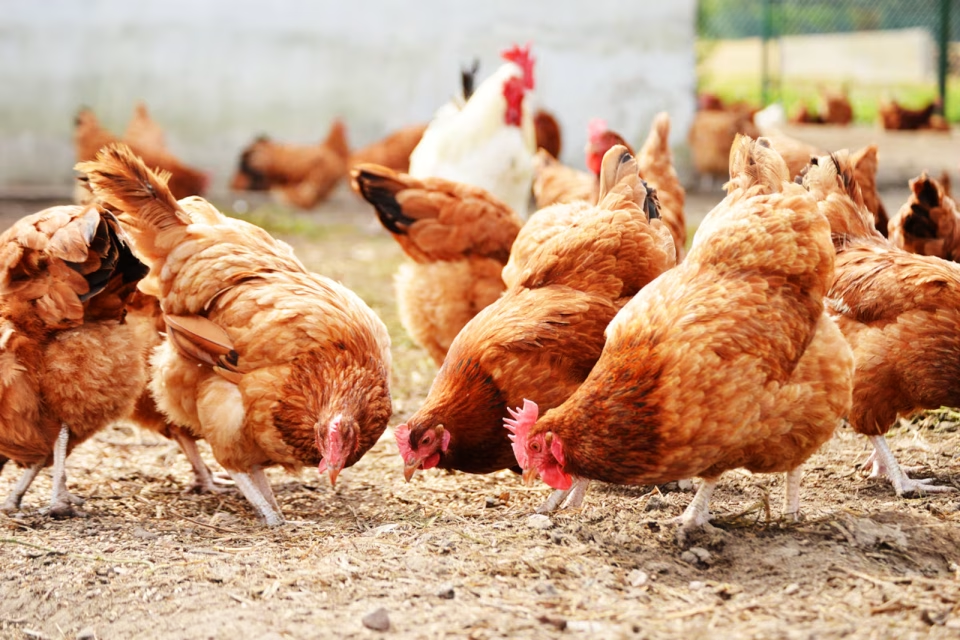
The review of antidumping duties on frozen bone-in chicken from Germany, the Netherlands and the UK raises a question that goes considerably further than whether those particular imports are being dumped.
After years of protection and substantial investment under the poultry master plan, at what point should South Africa expect its poultry industry to become progressively less dependent on protection?
There is no argument here against legitimate antidumping measures. If South Africa’s International Trade Administration Commission (Itac) establishes that dumping is occurring, and that removing the duties would be likely to result in material injury to the domestic industry, appropriate action is justified.
But antidumping duties are only part of the picture. South African poultry producers already receive substantial tariff protection. The general customs duty on frozen bone-in chicken portions is 62%. The antidumping duties presently under review are separate, additional measures applying to particular countries and exporters.
The protection afforded to the industry has not been without purpose. The poultry master plan, introduced in 2019, sought to increase local production, investment, employment and transformation while developing export markets. Considerable progress has been made and that should be acknowledged.
Indeed, the South African Poultry Association’s own website says South Africa’s poultry industry ranks second only to Brazil for global cost competitiveness and that its production costs beat those of Europe and the US.
That is excellent news if it is true and can be sustained. But it also makes it reasonable to ask when the benefits of increasing competitiveness should begin to flow more directly to consumers through greater competition.
Too often the poultry debate is portrayed as a contest between domestic producers and importers. There is a third party whose interests deserve at least equal consideration: the consumer.
Chicken is one of South Africa’s most important affordable sources of animal protein. For millions of lower-income households, relatively small differences in price matter.
The original poultry master plan itself recognised that imports have an important role in balancing the sector and specifically said they can help keep local prices in check. The same plan sought to reduce dependence on imports and to build an export industry.
That seems to capture the balance policymakers should continually examine. South Africa unquestionably needs a strong, sustainable domestic poultry industry. Food security, employment and agricultural development are important national objectives. But food security should not automatically be equated with self-sufficiency. A country can benefit from strong domestic production while retaining access to competitive international supply.
The second phase of the poultry master plan now aims for growth driven partly by exports, with improved biosecurity, greater local demand and continued effective trade measures. That too is encouraging.
Protection may sometimes be necessary to help an industry reach a competitive position. The danger arises when protection gradually becomes regarded as permanent.
Itac should therefore complete its present investigation and decide the antidumping issue on the basis of the evidence. If the legal requirements are met, the law should take its course.
But perhaps a broader question should accompany every application for another period of protection: what has changed since the previous application? How much more competitive has the domestic industry become, and what measurable benefit is the South African consumer receiving?
If our poultry industry has become as internationally competitive as the industry itself now argues, surely the ultimate measure of the poultry master plan’s success will not be how much protection the industry can retain but how little it eventually needs.
These are my personal views, based partly on my previous experience in the South African meat trade. I no longer represent any industry organisation.
