


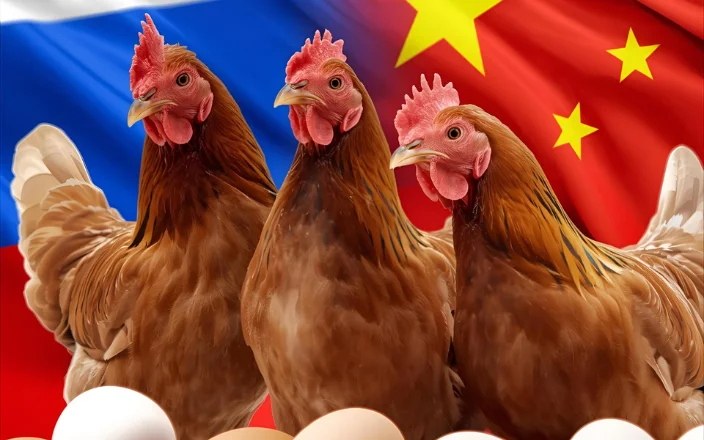
China and Russia are strengthening cooperation in poultry breeding through new agreements that could lead to joint ventures in genetics and breeding technologies. The collaboration highlights a broader global shift toward developing domestic poultry genetics—an approach that may also hold important lessons and opportunities for Africa’s rapidly expanding poultry industry.
Several leading agricultural research institutions from both countries, together with the Russian National Poultry Farmers Union, have signed an agreement to establish a joint scientific platform focused on poultry genetics and breeding. According to the Ministry of Agriculture of Russia, the initiative aims to promote research collaboration, technological exchange and the development of advanced breeding solutions.
Broiler crossbreeding collaboration
Alongside the research platform, a separate memorandum of cooperation has been signed between GenBioTech, a breeding company based in Kazan, and Beijing Glbizzia Biotechnology.
The partnership will focus on a broiler chicken crossbreeding programme designed to optimise breeding efficiency, improve disease resistance and extend the productive lifespan of poultry. These areas are increasingly important as global producers seek to improve productivity while maintaining biosecurity and sustainability.
A push for domestic poultry genetics
The agreements could eventually lead to joint ventures in poultry breeding as both China and Russia seek to strengthen domestic genetic capabilities and reduce dependence on imported breeding stock.
The initiatives were signed during a visit by a delegation from the Russian agriculture ministry to China. Officials noted that closer collaboration in breeding technologies could significantly enhance the scientific and technological capacity of both countries.
Relevance for Africa’s poultry industry
For Africa, where poultry remains one of the fastest-growing agricultural sectors, developments in global breeding technologies are highly significant. Many African poultry producers still rely heavily on imported breeding genetics and parent stock from international suppliers.
As African countries continue to prioritise food security, partnerships similar to those being explored by China and Russia could help accelerate the development of local breeding programmes and strengthen regional poultry supply chains.
In markets such as South Africa, Nigeria and Kenya, governments and private-sector investors are already exploring ways to expand domestic poultry production capacity to meet rising demand for affordable protein.
China’s rapid progress in poultry breeding
China has made significant advances in developing domestic poultry genetics. Since 2021, national research institutions and breeding companies have introduced genomic-based selection systems and developed several new high-yield poultry lines, including Shengze 901, Guangming No. 2 and Wode 188.
These locally developed genetics are now playing a growing role in China’s poultry sector, with some domestic layer lines accounting for an estimated 60% of the country’s egg-laying market.
Russia’s Smena-9 breeding strategy
Russia’s push for genetic independence is closely linked to the development of Smena‑9, a broiler crossbreed developed by Russian scientists and officially registered for commercial use in 2020.
The breed forms a key part of Russia’s import-substitution strategy. By 2025, Smena-9 reportedly accounted for more than 5% of the country’s poultry production, with government plans aiming to increase this share to around 20% by the end of the decade.
While the breed has made progress, some industry sources note that productivity levels remain slightly lower than those of established international strains, which has slowed large-scale adoption among major poultry producers.
Global implications
The growing cooperation between China and Russia highlights a broader global trend toward strengthening domestic agricultural technologies and reducing dependence on external supply chains.
For Africa, where poultry consumption continues to rise with population growth and urbanisation, such developments underscore the importance of investing in breeding research, disease management and modern production technologies to support long-term food security and agricultural growth.
